

At Jam Factory Art Center, on April 24 and 25 at 19:00, the premiere of Maria Bakalo’s solo performance “Again and Again and How It Will End” will take place — a work that grew out of personal memories and the collective experience of the 1990s. Combining bodily practice, childhood imagery, and reflections on war, trust, and vulnerability, the performance explores how to live and what to speak about in times of instability and global threats.
About the performance
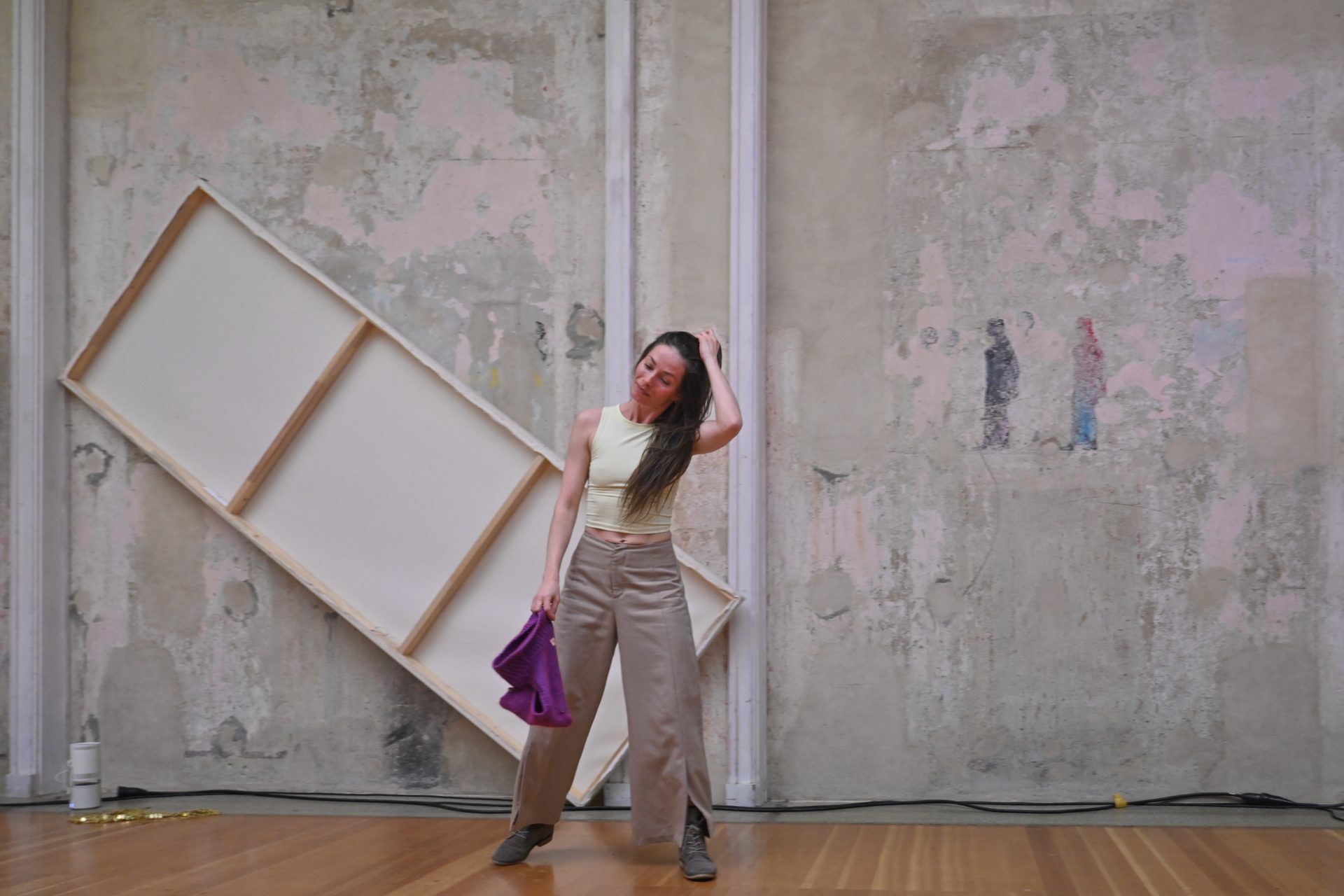
In her solo performance “Again and Again and How It Will End,” Maria Bakalo interacts on stage with a white sphere, dances, and constructs from various elements an image that is at once death, savior, and the Virgin Mary, while recalling her childhood. She tells the story of how, in the 1990s in Simferopol, she used to go to work with her mother at a military base.
Maria’s children are also present in the space — they have come to their mother’s workplace because there is no one to leave them with. They play video games, get bored, do puzzles, and interrupt the work.
The artist reflects: what is there to talk about on the threshold of a nuclear catastrophe, if not love? childhood? memories?
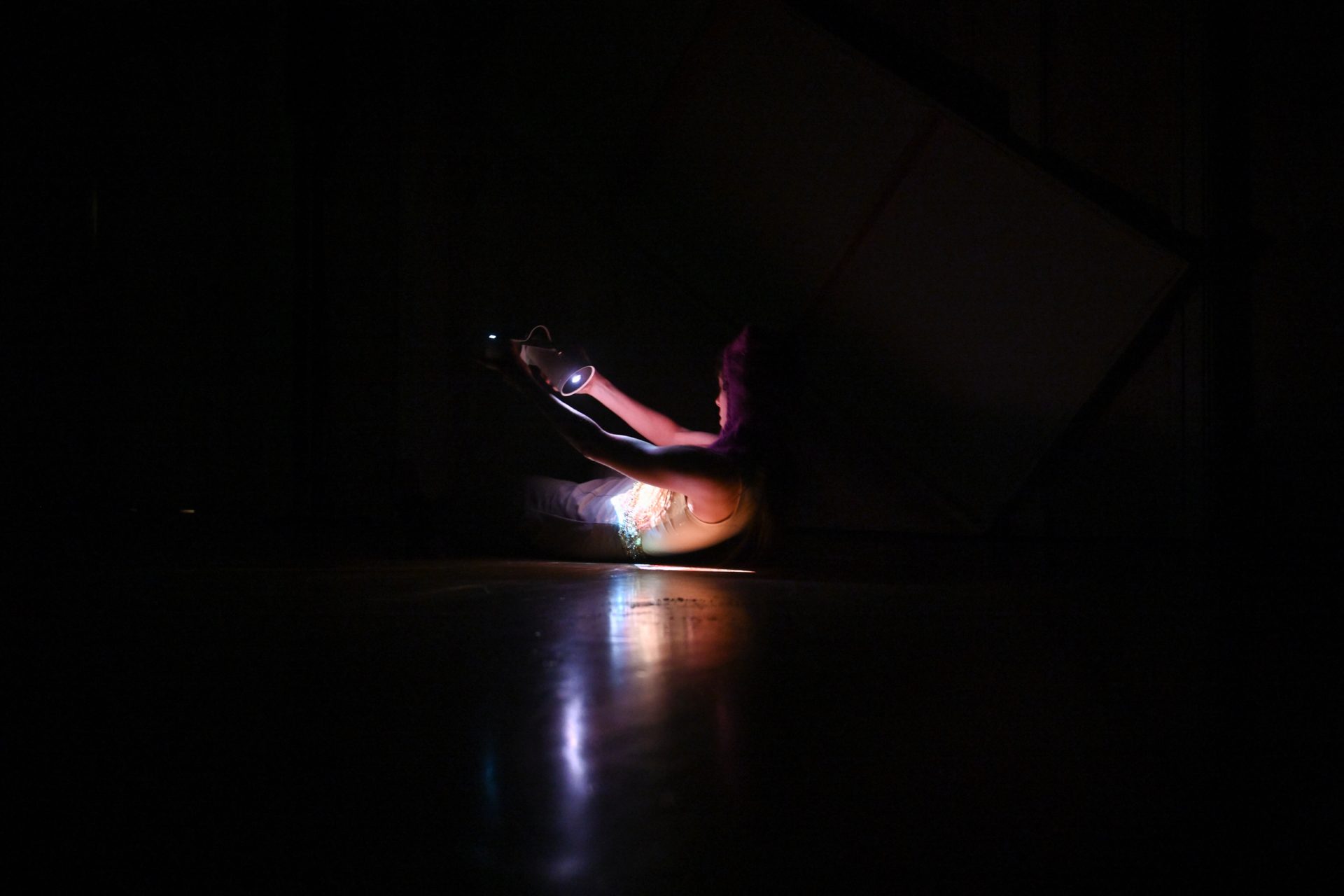
An inflated ball — a fitness ball — becomes an image embodying the core of danger. In interaction with this ideal yet unstable object, the performer’s body learns to remain in uncomfortable, vulnerable positions. Maria balances, takes a stance of resistance, and at times capitulates to the impossibility of finding stability.
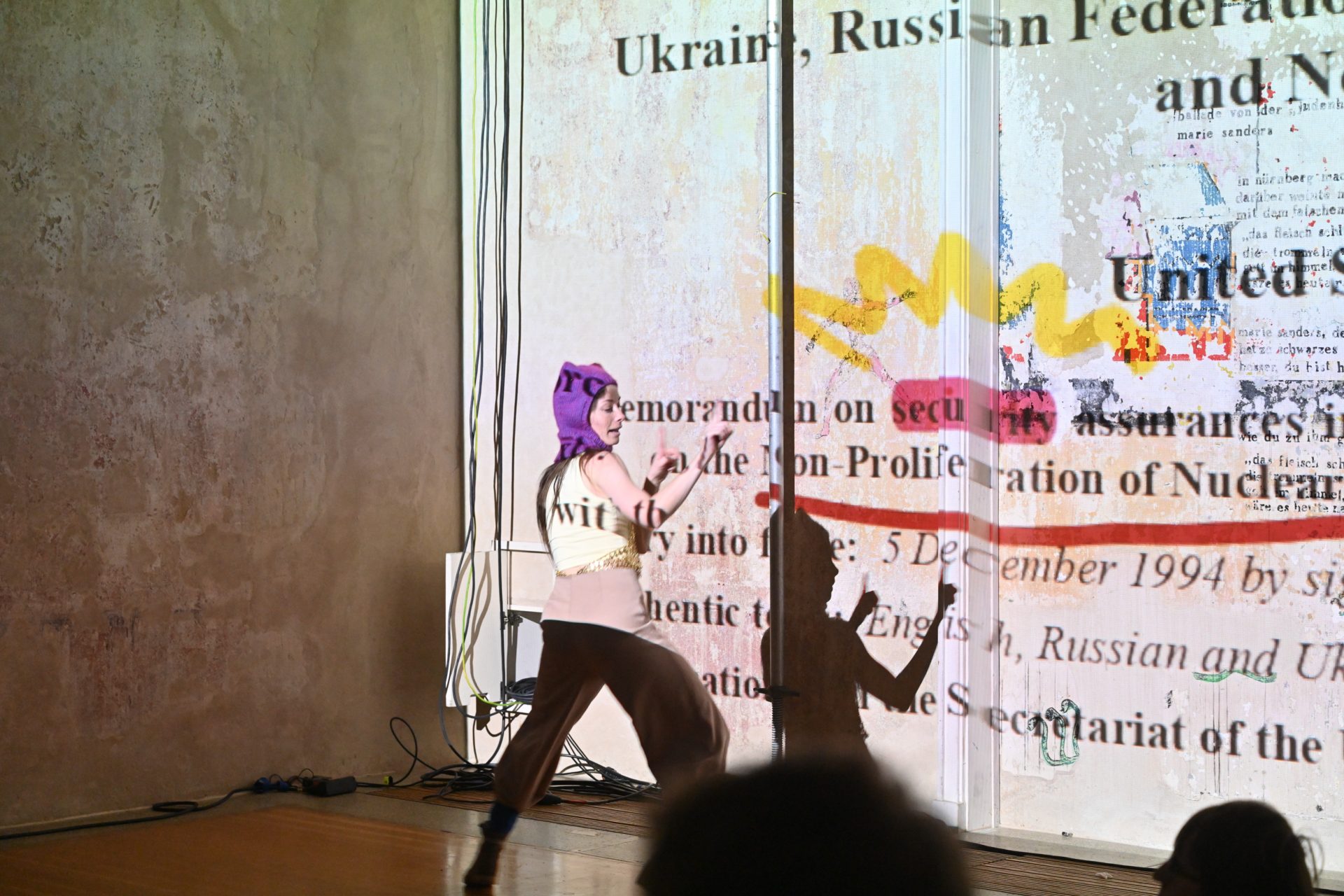
Referring to the history of Ukraine’s nuclear disarmament, Maria reflects on trust and betrayal, and on the value of a great act in the name of a higher idea — peace? loyalty to the state / international alliances? defense of shared values? Despite the urgent need for armed defense of the country, the artist considers whether giving up nuclear weapons could potentially be a step toward the future. In Ukraine’s case, was it a “choice in favor of life”? Does it now seem naive, misguided, shortsighted?
Digging into historical events and personal memories of the 1990s leads the performer to a painfully familiar experience: Ukrainians who lived in temporarily occupied territories did not betray their country, often at the cost of their own safety, yet after relocating to government-controlled areas, they face accusations of separatism. The state’s responsibility toward the “ordinary person,” the citizen, becomes blurred. Guarantees of safety and legitimacy are unstable. Repeated narratives about a “separatist Crimea” come at a high personal cost.
Balancing between the global threat of humanity’s destruction and the urgent routine of everyday life, Maria Bakalo places simple acts alongside major questions of security policy: caring for loved ones, doing puzzles, going to work, and the possibility of being together in a theatre.
Details
Date & time: Premiere shows on April 24–25, 2026, 19:00
Location: Jam Factory Art Center, 124 B. Khmelnytskoho St., Novo1 Hall
Tickets: 350 UAH. Available via the link.
About the author and performer
Maria Bakalo is a choreographer, dancer, performer, and contemporary dance teacher engaged in various educational initiatives. In her current practice, she explores questions of the futility and usefulness of art in times of major crises and profound human suffering. Her interests lie in the politics of touch and the weight of time. She is a recipient of the Gluck Fellowship, the I-Portunus grant, the DanceWEB scholarship, the Presidential Scholarship of Ukraine for cultural figures (2018), and the Tanja Liedtke Foundation scholarship. She has performed in the United States, Germany, Italy, Poland, Lithuania, and Romania. Maria holds an MFA in Experimental Choreography from the University of California, Riverside. She is also a certified teacher of inclusive dance practices for people with and without disabilities, based on the DanceAbility method.
Maria believes that through dance we can change the world. For her, dance is a transformative practice that allows us to shift how we inhabit our bodies and how we relate to our bodies and to one another.
How was the performance created?
In 2025, Maria participated in the Dreaming 90’s residency program, which brought together six art institutions: Komuna Warszawa (Warsaw), Workshop Foundation (Budapest), Jam Factory Art Center (Lviv), Studio Alta (Prague), Bunker (Ljubljana), and HELLERAU (Dresden). The participants explored how the social movements of the 1990s replaced rigid socialist systems and manifested dynamically in both positive and negative ways. They asked: which contemporary social, artistic, and cultural phenomena have their roots in the 1990s? What positive changes emerged during that period, and which opportunities were left unrealized?
One of the outcomes of the residency is this solo performance, created by Maria Bakalo in collaboration with composer Maryana Klochko and artist Jan Bachynskyi at Jam Factory Art Center.
Maria shares her reflections on the creative process:
“I am often drawn to things that are liminal or unstable — those that require constant balancing and do not offer clarity, certainty, or answers. The 1990s feel like exactly such a period: a time of transition, uncertainty, and possibilities — both lost and gained. It is a defining decade in the history of 20th-century Europe.
At the beginning of my research, I was interested in everyday life in the 1990s, particularly how ordinary Ukrainians documented it on VHS tapes. I paid attention to what people considered valuable enough to record and preserve as memories for future generations. Over time, this interest in the ceremonial aspects of everyday life shifted toward the choices made by my parents’ generation, then in their 30s and 40s — especially political decisions that shaped the future of their children.
Gradually, I moved toward the topic of Ukraine’s denuclearization in the 1990s. I reflect on various studies, including Mariana Budjeryn’s fundamental work Inheriting the Bomb: The Collapse of the USSR and the Nuclear Disarmament of Ukraine. The theme of generational responsibility, and the question of arming for the sake of peace and life — or disarming for the same purpose — is now central to my work.”
Team
Author, performer – Maria Bakalo
Composer – Mariana Klochko
Artist – Jan Bachynskyi
Projection – Yelyzaveta Postol
Production manager – Vlad Bilonenko
Maria Bakalo’s children — Tereza and Orest, or one of them — are often, though not always, present in the performance space.